
Lowpad Case Picking
A software-driven approach to case-picking that
delivers around 40% higher efficiency.
Get an insight into
Lowpad Case Picking.
Lowpad Case Picking.
Dynamic zones
Lowpad Case picking optimises pick performance by directing pickers to busy areas. In traditional zone picking applications, each picker has a fixed zone where they perform all picks. This has many drawbacks. For example, the picker with the busiest zone limits the total throughput, while other order pickers are often idle because there are no picks to be done in their zone.
Lowpad Case Picking mitigates these issues by continuously adjusting the zones to the picks that can be performed quickly. In busy areas, there will be a lot of smaller zones, whereas areas without a lot of picks may be covered by a single zone. This ensures that the order picker's idle time is minimised, and pickers are always optimally distributed over the warehouse. Because voice picking or a similar system is used to direct the order pickers towards picks, they do not need to be aware of the boundaries of their zone.
The dynamic zones are also very responsive to changes in order picker availability. When a picker joins or leaves the process, the dynamic zones are adjusted to optimise the throughput again.
Pre and post picking
In the pre-picking phase, the Lowpads retrieve empty containers and drive to their first pick location without a picker's intervention. This frees up more time for the order pickers to focus on picking. The post-picking phase involves driving from the last pick to the outbound area and bringing the container to the correct dock. Lowpads that have just completed a pick run continue to the marshalling process to deliver the container to the correct location. Since order pickers no longer have to deliver containers, more time is saved and the possibility of errors is reduced.
Voice picking
The combination of Lowpad Case Picking and pick-by-voice technology, based on speech recognition, enables voice-controlled work in a warehouse setting. Using this technology, each employee is equipped with a voice terminal and headset complete with a microphone. Orders are communicated to employees via spoken instructions, which are immediately confirmed in real time.
More picking, less walking
Transforming case-picking through orchestration by advanced software
Case-picking is one of the most labour-intensive and performance-critical processes in retail distribution. Walking distances, unbalanced workloads and waiting times limit throughput and make scaling increasingly difficult.
Lowpad Case Picking fundamentally changes how case picking is organised. As part of the Lowpad Software Suite, it introduces a new way of working in which software orchestrates interactions between order pickers and Lowpad AMRs, creating a continuous, demand-driven picking flow.
What changes when software takes control
A different approach to case-picking
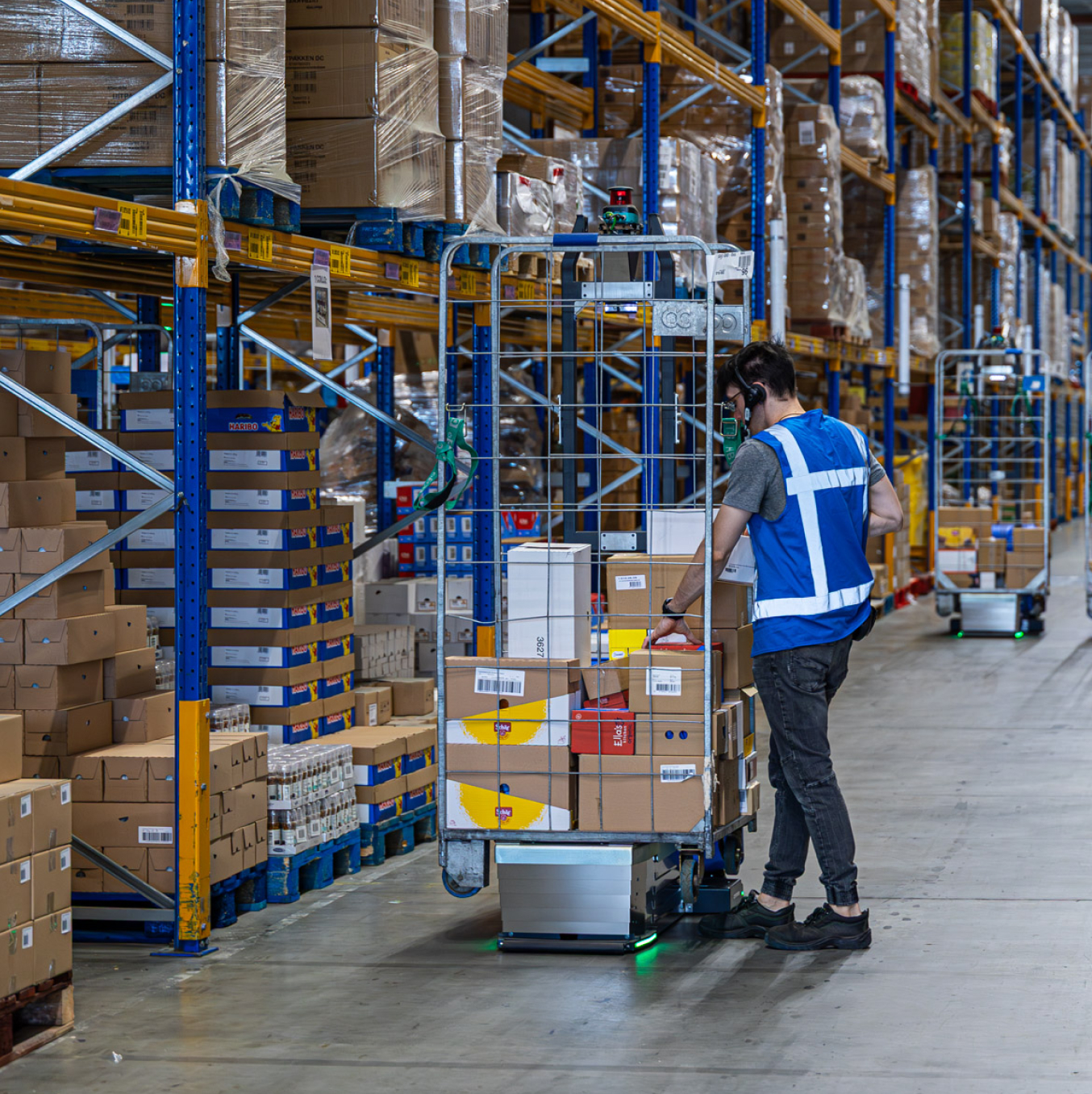
Traditional picking processes tightly couple order pickers and load carriers. Pickers travel long distances, collect roll cages or pallets themselves, and spend valuable time on transport rather than picking. Lowpad Case Picking separates these roles by design. Lowpad AMRs transport load carriers between pick locations and outbound areas. Order pickers are dynamically guided to the next optimal pick location, where a roll cage or pallet is already waiting. This separation eliminates unnecessary walking and handling, allowing pickers to focus entirely on picking.
Software in control of the picking flow
At the core of Lowpad Case Picking is software orchestration. The system continuously balances demand across the warehouse, directing both AMRs and order pickers based on real-time workload, priorities and location.
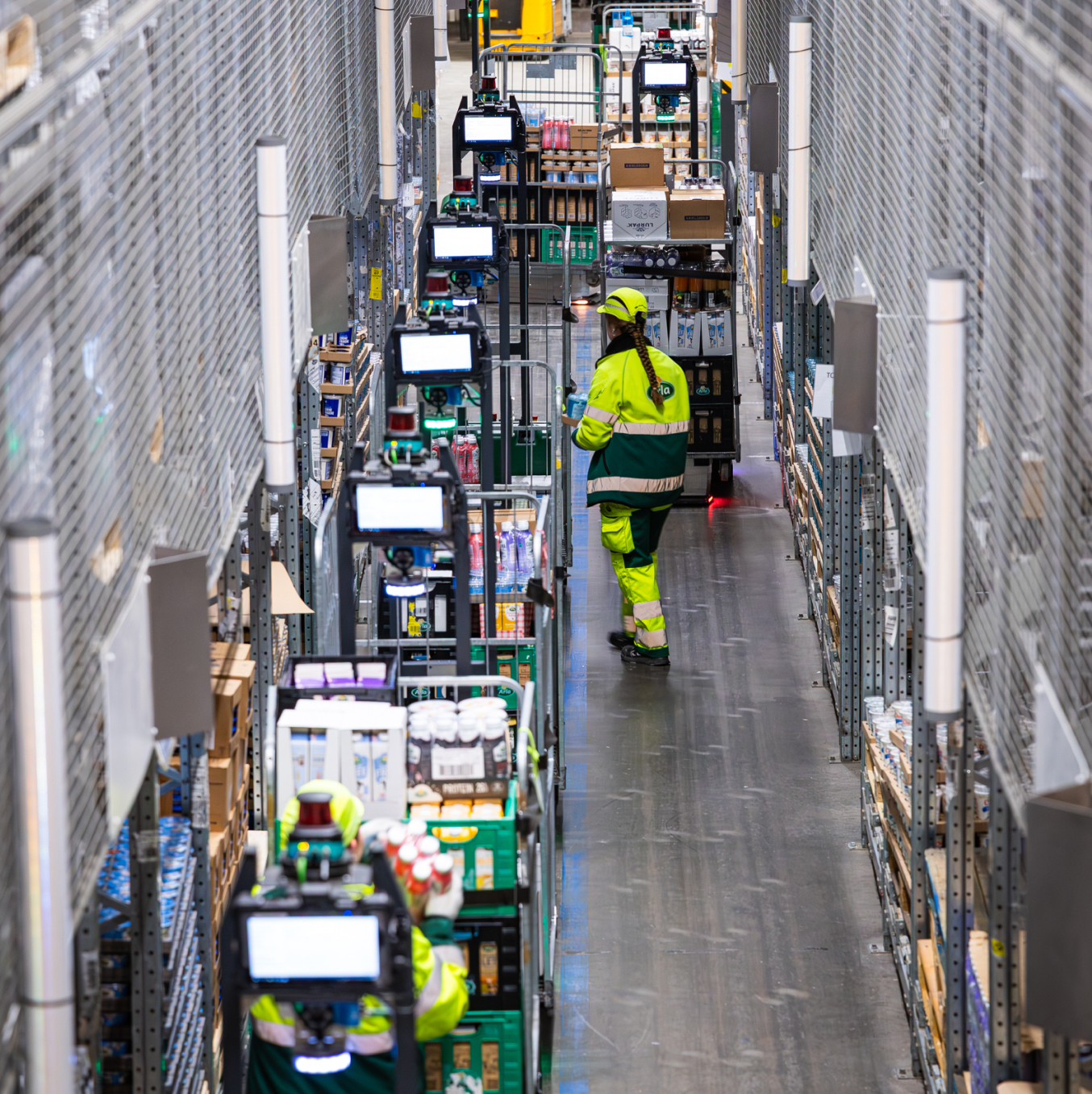
Pickers can pick from any nearby roll cage or pallet within their zone. If the next pick is close, they continue with the same load carrier. If demand shifts, they are guided to another pick location where another Lowpad AMR is already positioned. This creates density, reduces idle time and keeps picking flows moving.
Zooming out, the system dynamically manages picker density across the warehouse. High-demand areas attract more pickers, while low-demand areas are automatically relieved — without manual intervention.
Lowpad Case-Picking
The benefits
01
A different approach to case-picking
Lowpad Case Picking separates the roles of order pickers and load carriers. The AMRs handle all transport, while pickers are guided to the next optimal pick location where a roll cage or pallet is already waiting. This eliminates unnecessary walking and allows pickers to focus entirely on picking.
02
Software in control of the picking flow
At the core of Lowpad Case Picking is software orchestration. The system continuously balances demand across the warehouse, directing both AMRs and pickers in real time based on workload, priorities and location; creating density, reducing idle time and keeping picking flows moving.
03
Measurable impact
By separating transport from picking and putting, and placing software in control of the flow, Lowpad Case Picking delivers around 40% higher efficiency, making it a measurable step forward for any retail distribution operation looking to scale without adding headcount.
transition today